Showing posts with label HayaoMiyazaki. Show all posts

Thursday, March 8, 2012

MR Nausicaä


This week, let's look into what is considered the first Studio Ghibli movie (though it isn't!)
If you want to check out my previous reviews, follow the Ghibli-Marathon tag or simply click over the above picture!

Considered by many, a classic of the Japanese animations - for both fans of anime or not. Let's review Miyazaki's big independent debut...

Movie: Nausicaä of the Valley of the Wind 
Directed by Hayao Miyazaki
Release date 1984
Genre Anime/fantasy adventure
Country Japan

Nausicaä of the Valley of the Wind is a post-apocalyptic animated filmd written and directed by Hayao Miyazaki, and produced by his long time friend and co-animator Isao Takahata, who had both been trying to launch their own anime studio for years.
Tired of all the usual commercial and cheap productions Japan had been producing for years, he experimented making movies for larger audiences with more mature content and serious production values.

The story of Nausicaä was actually based on a manga going by the same name, drawn and written by Miyazaki. Serialized from '82 to '94. it is about a princess from small kindom that is then brought into a war between empires. She tries to seek the coexistence between these different nations why preventing the humans own selfishness and ambitions from destroying nature in the process.
The movie is actually the adaptation (more or less) of the first chapters (2 of the 7 volumes).

Nausicaä is therefore an adaptation of a manga...which itself was originally inspired by the character Nausicaä from Homer's Odyssey. This character served as basis for Miyazaki's story. The daughter of King Alcinous, trying to bring back peace in the middle of a imperial war amongst nation.

But back on the movie itself, shall we?


The film tells the story of Nausicaä, a young girl, princess and fighter from the "Valley of the Wind" who gets involved in a struggle  between empires.

But let's start at the beginning first.
The story takes place a 1000 years after an apocalyptic event, called the "Seven Days of Fire", it was a cataclysmic war that destroyed both the planet's civilizations and ecosystem.
Now, there are Toxic Jungles all over the world, also called the Sea of Decay, where the air is toxic and there lies giant insects, the result of various evolutions and aberrations, nature's answer to man's destruction.

Nausicaä lives in this Valley of the Wind that is a place relatively protected from the toxic spores thanks to the air coming from the ocean.
A wise and mysterious man who lives there from time to time, called Master Yupa, is searching for the "Man in Blue", he who will unite the people back with nature. To help him out, Nausicaä goes on exploration, searching from jungle to jungle and beyond the desert for this mysterious savior.
She uses this flying glider, a Möwe, to move around.

Nausicaä is actually sort of able to talk to these giant insect creatures and would love to see peace returning to the world..
She is particularly found of the "insect kings", the Ohmus/Ômus (depending on the version of the film).


One day, a giant airship crashes near the Valley.
Nausicaä notices it and tries to rescue a little girl she sees aboard.
The villagers soon find out it is the princess Lastelle of Pejite.

Which brings war to the peaceful village.

The war is still going between various rival kingdoms. A military flying ship from the Tolmekia (/Tolmek/Tolmèque) Empire comes around.

Nausicaä discovers an embroy of a Giant Warrior in the first crashed airship - which are dangerous weapons created by man from the old war.
Lastelle was actually trying to destroy the monster, these embryos need to be destroyed!

But the empire Tolmekian wants to resort to what originally destroyed the world in their conflict against the Dork Empire.
The Princess Kushana and General Kurotowa invade the valley for the embryo...

Meanwhile, Nausicaä finds out the jungle is actually toxic because of what people did to the ground, plants actually grow in water beneath the sand and jungle.

The Tolmekia kingdom tries to use an ancient weapon too soon, to fend off from an Omhu attack...
Nausicaä must stop the Tolmekians from killing these insects, the survival of the planet depends on it!


Let's simply say it, Nausicaä is a gorgeous looking animated movie, with great animation quality, an amazing atmosphere and feel, a mature tone, fantastic orchestral music compositions and a great story to boot.

Miyazaki and his very competent staff did the impossible, made Japanese animation relevant again and popular worldwide with both fans and critics alike.

The movie's production was done in a record time of under 10 months (!!!) for a budget of about 1 million $USD, which at the time was a lot and without precedent.

It helped establish the Studio Ghibli, which would be the home of various other Miyazaki and Takahata films for the following decades. That is why it actually is often considered part of Ghibli's filmography and legacy.
It went on to win several prizes and breached  various records of the JKapanese box office and worldwide as well.

Originally Tokuma Shoten wanted to turn Miyazaki's Nausicaä manga into a movie, but Miyazaki preferred to take the occasion to do so himself. It was then released by Toei on March 1984.

There's a lot of Takahata as well as Miyazaki in this movie.
It really is a joint effort to launch their Studio Ghibli.
There's a lot of inspiration both brought in from their previous productions. Be it from Lupin or Horus. Mostly esthetically.
And as fantastic as it is, it is a story of characters before anything.
Ghibli's first leading female heroine, a model for generations to come.


Overall, it is a must see, simple as that.
Beautiful gorgeous looking, great and entertaining.

It's a movie for all, all ages and wherever you come from. It's an universal kind of story.
People fighting for peace, people raging war, nature being ignored and caught in the middle.
Environmentalist and meaningful.

But please, I will add this to this conclusion, please don't watch the butchered US translation from the late 90s - also re-released on DVD for some reason.
Avoid the version of the movie translated under the name Warriors of the Wind at all cost!!
It was heavily edited and modified to be more "manly" and less "girly" as stereotypical 80s American cartoon companies would have put it. Avoid this release!!

Anyways, Nausicaä is a must watch!

I give it:

2.5 / 3 DonPatchis!

Sunday, January 1, 2012

MR The Castle of Cagliostro


Let's start off this year with a whole new review!
This time I would like to offer you yet another entry in my long running Studio Ghibli Marathon.

This yet another "Ghibli-esque" movie from the pre-Studio Ghibli era. Taking you this time in the late 70s...

Movie: Lupin The III: Castle of Cagliostro also simply known as The Castle of Cagliostro
Directed by Hayao Miyazaki
Release date 1979
Genre Anime/adventure
Country Japan

Castle of Cagliostro is one of the earliest features around Lupin III, it is actually Lupin's 2nd movie adaptation.
Released only a mere year after the first one, The Secret of Mamo.
It was co-written and directed by Japanese animation master Hayao Miyazaki and originally one of his biggest projects to date.

Lupin 3 was at first a manga created by Monkey Punch (pen name of the mangaka Kazuhiko Katō).
It is about this international thief called Arsène Lupin The Third who is, yes, the grandson of the fictional character created by Maurice Leblanc.
Due to copyright issues and trademarks, Lupin has been forced to go under various other names depending on the translations and years they've been released.
Depending on the movie/TV series you'll see you might find him under the names: Rupan III (recent materials), Edgar (like most of the French releases, like mine picture above), Wolf or even Vidocq IV (true enough)!
For the sake of simplicity, I'll just use Lupin, ok?

In his adventures Lupin III is often accompanied by other thieves and criminals-for-hire and finds himself in very dangerous and often random situations.

Meet our heroes!

This second film takes off as our main character is pulling off a job in a casino in Monaco.

Lupin II and his acolyte Daisuke Jigen, a mercenary, barely make it outside the premises...
As our heroes escape in their famous Fiat 500, Lupin notices they actually stole fake money that has been spreading all over the world since a dozen of years or so...

Lupin convinces Jigen to attack the problem at its source and go after the people that have been spreading this fake money around.
Their journey takes them to (the fictional) Cagliostro, somewhere in mid-Europe.

But as soon as they reach their destination, trouble follows them quickly and they find themselves having to protect a girl from being kidnapped....

You'll never find a more well-mannered Lupin anywhere else!

Long story short, Lupin ends up having to rescure this princess, Clarisse, from the clutches of the evil Count of Cagliostro.
They find themselves in peril against the overwhelming forces of the Count's elite assassins, so Lupin call in some exterior help. The ronin Goemon Ishikawa XIII is quick to answer to his friend's.
And the head of an Interpol anti-Lupin task force, Inspector Koichi Zenigata finds the steps of Lupin leading him into the castle as well.
Meanwhile, international criminal Fujiko Minewas already way ahead of everyone else on the quest for the hidden treasure the Castle of Cagliostro hides beneath its underground...

As you might get from this crazy plot, it sort of goes everywhere but stays pretty focuses at the same time.


This movie's a fun adventure with lots of twists and turns around each corner.
Miyazaki based the movie around several Arsène Lupin stories actually. The movie uses some plot elements and alludes to La Comtesse de Cagliostro an original Lupin story from Leblanc, as well as taking some inspiration from La Justice d'Arsène Lupin by Boileau-Narcejac (mostly the forged money aspect, which concerned fake Francs during a WW1 era Germany in the original) and Maurice Leblanc's The Green-eyed Lady.

Aesthetically though it's totally a Hayao Miyazaki movie.
The tone of the movie makes it stand out amongst the various other Lupin 3 productions. From using Miyazaki-esque backgrounds and settings (the nature, the colorful realistic country, the castle..) to the plot itself.
As such, it features a much simpler and gentler Lupin & co. Even keeping Jigen aside I presume is a way of having less of the usual gun ho action on screen (and Goemon's even less present, barely making an appearance for fans simply). Though I must say Zenigata's perfectly in-character.
Also this is probably the movie were Miyazaki's influences can best be seen represented in the animation, particularly the 1952 classic French animated movie The King and the Bird (Le Roi et l'oiseau) from which Cagliostro takes a lot of cues from the castle's design to various designs, shots and animations.

Finally a note for the musical aspect.
The music here was composed by series regular Yuji Ohno, which perfectly captured the movie's tone and atmosphere in sound. The score is simply epic, fitting for such a crazy adventures featuring lots of chasing around and action, as well as some deeper emotions and more serious scenes too.


Overall, a fantastic movie!
Fans of animation, Ghibli, Lupin III or simply adventure films, don't miss this one out!

This Toho production helmed by Miyazaki at the top is one of the classic film features from the master of animation I can't recommend enough!
It can also work as a great introduction to the crazy universe of Lupin II (even if you'll call him Wolf, Edgar or Rupin III!).

A must watch, fun for all ages!

I give it:
2.5 / 3 DonPatchis!

Wednesday, November 2, 2011

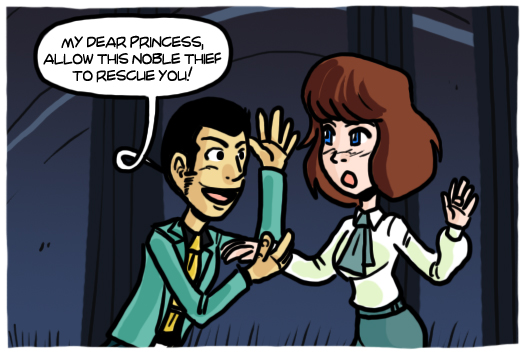
COOLAPE Wednesday - Totoro


Link for the full comic on CoolApe:
http://www.coolape.org/comic-eyz-totoro.html

When Hollywood needs more ideas to turn into a movie... they turn their eyes to foreign proprieties!

Kind of a sequel to last year's

Wednesday, September 7, 2011

Panda! Go Panda! - opening

I was saying how awesome the main theme (and the general sountrack) was in Panda! Go Panda! in my latest review.

But I didn't show it properly.

So here's both OVAs' opening title screen for you all to enjoy!


So catchy~
:)

"Panda Kopanda Kopanda!!~"

Monday, September 5, 2011

MR Panda! Go, Panda!


And here's another review for my "Studio Ghibli Marathon"!~

Some nerds would love to nitpick, and scream at their computer screen saying "this isn't a movie! it's an OVA/OAV!!" well, check out my tags, notice my "OVA" tag? Good. Okay, now calm down, sit, relax and enjoy....

Movie: Panda! Go, Panda! also known as Panda Kopanda which means Panda, Baby Panda (as most non-English releases correctly translate the title - see my own copy above!)
Directed by Isao Takahata
Release date 1972
Genre Anime/comedy
Country Japan

After working together on Horus at Toei animation, Yōichi Kotabe, Hayao Miyazaki and Isao Takahata started working on another feature in 1972.
This, instead of making a full theater feature, for budgetary concerns which was still a problem for them at the time, they decided to work on a smaller, and shorter, project.
This time it was going to be an OVA, that is, simply a direct-to-video feature (which aired on TV nonetheless).

Hayao Miyazaki created the concept and wrote the film, that Isao Takahata directed in the end.
This time the movie has more noticeable "Miyazaki" flavor, every detail, character and aspect of the plot clearly contains his very own touch.

 Panda! Go, Panda!

The "movie" that we call nowadays "Panda! Go, Panda!" is really two smaller short features, two OVAs.
Both run for around ~40 minutes, which back to back can sort of be seen as a proper movie...kinda...

The story is about Mimiko, a little girl without parents, who lives with her grandmother in a little hometown.
One day, her grandmother has to leave her alone for a trip. But Mimiko is full of ressources and has no problem staying all by herself, being quite enthusiast and responsible at home.
When she comes back to her house later, situated in the middle of a bamboo forest, she finds there a baby panda sleeping outside.
Pandy (in Japanese Kopanda or Pan-Chan or even Panny in some US releases) joins her inside the house and they quickly become friends.
They're joined by his father, Papanda (Papa Panda), whom Mimiko ends up inviting as well!

A very strong bond is born amongst these three, and in the spur of the moment, they decide to become a "real" family, Papanda serving the role as the father she never had.

Mimiko continues to write to her grandma every night.
The next day, she goes to school and Pandy decides to follow his new "mom" there. But the lil' panda ends up getting chased by everyone....
Day turns to night, Mimiko continues her dialogue with her grandma through another letter.
The following day, trouble comes to visit this unusual family as the local Policeman wanting to check on Mimiko freaks out when he sees two escaped pandas over there. He calls in help and the local zoo is alerted someone found their lost panda family.
Our little family went for a walk, but loses Pandy down a hill, into a river. The police come to aid them as well as the zoo keepers. Mimiko and Papanda have to save him!!

In the end, both pandas return to "work" at the Zoo only now they can leave after hours to live happily with Mimiko at home...

Panda! Baby Panda!

The second short is called "The Rainy-Day Circus".
This one has a sort of different tone, more adventur-ysh. It was originally released a year later, with a brief recap of the original one when it aired in theaters in front of a Godzilla feature. (true!)

One night, our happy family is visited by what comes like a strange duo of burglars. In what seems to be a direct reference/spoof to the fairy tale of The Three Bears, our "burglars" find the chairs, dishes and belongings of our trio, tiny, normal sized and huge stuff from Pandy, Mimiko and Papanda!
...When the three decide to surprise their intruders, who get scared and run off...
But continuing this allusion to the tale of Goldilocks, Pandy finds out someone sat, ate and is sleeping in his bed. It's a baby tiger escaped from the Circus in town!
This Tigry (Tora Chan or Tiny in the US) quickly becomes fast friends with Pandy.

Trouble arise the next day, but all is well as Mimiko gets free tickets for the show for her, Pandy and the Papa Panda. But a big storm arises over night which floods most of the town...
Mimiko and her family go to check on their new friends at the Circus, stuck in the middle of nowhere on the train!
They help the animals, start the train by accident, which go off rails...

The seeds of various future Ghibli features grew from this film!

This movie original hit Japan at the height of the panda craze which started in the early 70s.
When a pair of giant pandas had been given to Japan by China at the Ueno Zoo, when everyone there was in love with pandas. What some refer to as the "Pandadiplomacy".

This movie marked one of Miyazaki and Takahata's first biggest success, when they could really let go outside the restraining format of TV series (though not exactly like later on, on theaters, with budget and more time on hand).

Both these two adventures are very well animated, simple yet quite fun.
The music was composed by Masahiko Satō, it's a very dynamic and entertaining soundtrack. The main theme "Mimi chan to Panda Kopanda" is super catchy. ("Panda Kopanda Kopanda-!!")
Both features where done at the Studio Tokyo Movie Shinsha.


Overall, it's a very fun "film"!
While Horus was clearly one of the first animated films for a more adult audience, with a complex storyline and characters, featuring a various range of emotion, Panda! Go, Panda! was produced with children in mind as its principal audience.

But it still is a good heart warming movie for "older" Ghibli fans! The movie is full of fun little tidbits fans will enjoy.
It is principally a Miyazaki film more than a Takahata one. Simply because of Miyazaki's input throughout both features. As such, there's the seeds to many of his later films. Like a known fact, your earlier debuts often leave a mark across your whole life and later work.
The most evident being on Totoro. Papanda shares many of his traits, including his basic design, animations and even a bit of his personality (though Totoro isn't as eloquent). Both even share a little "playing music" scene which doesn't play a big role in the movie and is quickly overseen.
The second feature was also sort of reimagined in the recent Ponyo.
The flood, in which the village gets trapped beneath the surface, is almost identical in both movies. A violent storm arise while in the middle of a meal. The next morning, the rain has stopped and both character's world in the two movies is invaded by water. Our heroes leave aboard a boat to help their friends... The theme, the narration, the way it is directed is more than similar!
Our heroine even served as template for a later anime series, Heidi, Girl of the Alps.

Speaking of which, the movie isn't without some influences as well.
Before making these two features, Miyazaki searched for a really long time after Horus to adapt Pippi Longstockings into an anime movie.
It came really close to be their second feature, he had a lot of interest in the character (the title was going to be Pippi Longstocking, The Strongest Girl In The World ). In 1971 they traveled to Sweden to research for the film (they even went to Visby, the principal location from the 1969 live series) and asked the permission to the creator, Astrid Lindgren...who finally refused. The project was canceled...but not dead!
Besides some storyboards and concept (see here, here and here), the rest that was saved from that production ended up being used in Panda! (such as Mimiko, a redesigned Pippi)

There's also other references, like the Policeman sharing Lupin 3's design (an anime series Miyazaki worked on for a very long time), even being voided by Lupin's official voice actor (in all of its movies/tv series usually), Yasuo Yamada.

But it is also a Takahata movie afterall. And since the stories are quite short, the way our heroine's introduced and other characters as well is through little details in everyday life.

Anyway, it is a great movie, moreso for Ghibli fans and children alike!

I give it:
2 / 3 DonPatchis!

Friday, September 2, 2011

MR Horus: Prince of the Sun


With this review, I'm gonna start what I've been wanting to do for quite some time now... what we will call the "Studio Ghibli Marathon"!
But instead of going through the usual Spirited Aways and other Totoros right from the start like everybody else, I wanna take a look at the more obscure Pre-Ghibli movies as well.

So without further ado, let's start from the very beginning...

Movie: Horus: Prince of the Sun and also known as The Sun Prince - Hols' Great Adventure  aka The Little Norse Prince or Little Norse Prince Valiant
Directed by Isao Takahata
Release date 1968
Genre Anime/adventure
Country Japan

Started in 1965, Horus: Prince of the Sun's production was finally finished a bit shy in the middle of 1968 only. Why did an old anime movie from the 60s take so much time, which was quite unusual for the time, a simple original movie which wasn't even an adaptation from an important work or manga?

Because of the various troubles that were happening behind the scenes. A conflict arose between the creative team (composed mostly of animation director Hayao Miyazaki and director and producer Isao Takahata) with the producers at Toei.
This was long before they co-opened their own animation company, Studio Ghibli.
It was in fact Isao Takahata's first film debut. Before that he and Miyazaki both worked on television anime series. Several animes, amongst them, the more famous across the world were Lupin III, Heidi or also Future Boy Conan...
Anyway, they had problems over budget disputes.

You see, they wanted to make a movie they'd want to watch themselves, with content and interesting themas to explore. But Toei was only interested in making a cheap movie for kids.
Takahata and his crew were also quite demanding regarding to the quality of the final product.

This movie marks the starting point, for Japanese animation, when creators (writers, artists, directors,..) took the reins behind the direction of their movies from the hands of producers and companies.

It also united for the first time Isao Takahata, Hayao Miyazaki and Yoichi Kotabe who would go on to make their own studio, leaving Toei, becoming independent and making such movies as Panda Ko Panda. [Eyz note: we'll see this one later!]

Our hero begins a journey the same way King Arthur did... errr...not quite though..

The story opens with Horus!
[note: "Hols" in some American releases..]
Horus is a young boy. He is first seen fighting against a pack of "silver wolves".
In the middle of it all, Horus wakes up an ancient stone giant nammed Moog. [or Mogue]
After helping this giant pull out an horn from his shoulder, which turns out to be a mystic sword, the gentle giant makes a pact to Horus. He will leave this Sword of the Sun in his hands, if he promises to forge it (the sword is all rusty and old..), in return Moog will return to aid him that day and Horus will be hence known as "Prince of the Sun" according to an old legend.

Returning to his home, Horus finds out his father died in the meantime...
Horus ends up swearing a second oath that day. He will return to his father's old village, in the north. It was destroyed many years ago by the evil sorcerer Grunwald.
Horus promises to avenge his village.


Horus goes on a journey to the northern villages, accompanied by his friend Coro, a bear cub.
There, Horus finds Grunwald quite easily. Grunwald, in true evil sorcerer fashion asks him to join his side...to become his "brother", so he'll take care of him and will help Horus become powerful and feared like him...but Horus refuses...

Finally, Horus finds an inhabited fishing village. He helps out the village, takes care of an enormous monster that was terrorizing the lake nearby and finally settles in.
He ends up meeting a lone girl wandering around in the remains of his father's old village. This girl, called Hilda, is brought back to the same fishing village. She spends her days singing for the villagers.

Everything was going fine, right? All's well in the end...but the chief of the village starts resenting these newcomers, Horus' popularity amongst the inhabitants is annoying the chief. His deputy Drago starts spying on our hero and planning a way to kick the intruders out.

In the last act, things get going badly, Horus finds out Hilda is Grunwald's "sister" (or is she...?), the village gets attacked on all sides and from withing, and Grunwald makes his presence felt....


This movie was produced by the animation studio Toei Doga.

The story, if a bit straightforwad, seems pretty rushed. Takahata and co were used to the television format, and such the structure you'd find in an episodic series is sort of felt through the movie.
But as forward and rushed the story seems, it still is a pretty good movie.
The art and animation isn't 100% consistent all the way through, but I think it makes the charm of a 60's anime movie.
It still is of great quality. And the voice acting or music only helps make this movie come to life even moreso.

The story takes place in the Scandinavia around -500 (BC). The whole movie reflects this "Viking era", without resorting to clichés or your classic elements you would find in stories taking place during that age.

It's a great movie, if a bit less known from Miyazaki and Takahata's other productions.


Overall, a great movie.
Simple, but fun. The characters come out a bit sketchy at first glance, but they're properly developed over the course of the movie.

Grunwald is specially a good villain even if he comes out plain "evil". He is quite mysterious in the end, he seems to be a normal man that has turned to evil and who's promised himself to get rid of all mankind. Using animals (giant fish, wolves, etc..) to help him on his devilish quest.

The movie explores some similar themes to the later Ghibli movie Laputa. Even some characters like Pazu or Sheeta seems based on these earlier characters Horus and Hilda who probably served as protypes for them. (even in their designs)
The story seems to draw a lot from the novels of Ursula K. Le Guin, the tales from Earthsea from 1964 (published from '68 to 2001), which Miyazaki admitted being a big fan many times. He wanted to make a movie based on Earthsea for many years, until his own son ended up being the one to direct an adaptation in 2006.

Anyway, it's a good movie. Give it a try if you found yourself interested in it!

I give it:
2 / 3 DonPatchis!

Wednesday, August 17, 2011

Anime News! The upcoming(s) new Ghibli movie

Here's a (japanese) trailer for the latest movie produced by Studio Ghibli.
Kokuriko-zaka kara (From Kokuriko Hill/From up on Poppy Hill).


It was released not long ago in Japan (only for now).
It is the second production directed by Goro Miyazaki. And unlike his previous movie (Earthsea), it's getting a very good reception and reviews. Though it is not making a lot of money. (blame a very poor marketing compared to previous Ghibli movies, or a release around the latest Harry Potter, which Japanese love as well)

On a related note, Hayao Miyazaki revealed some informations regarding his own future Ghibli production.
Development was started already. And it's sheduled for 2-years long of production time at least.
It's going to be a big budget title for summer 2013.

It will also take place during the Showa era, before Goro's movie above, probably around the 30s or 40s.
It will take place in a realistic setting this time.
It is an adaptation of an auto-biographic story.
They will use approximatively over 250 000 celluloids to animated it (around the double of what Sen to Chihiro/Spirited Away used).

Besides that? Not much information for the moment regarding the plot/story/characters...
I guess Joe Hisaishi will return to score the music.

And that is all for this time~

Sunday, August 7, 2011

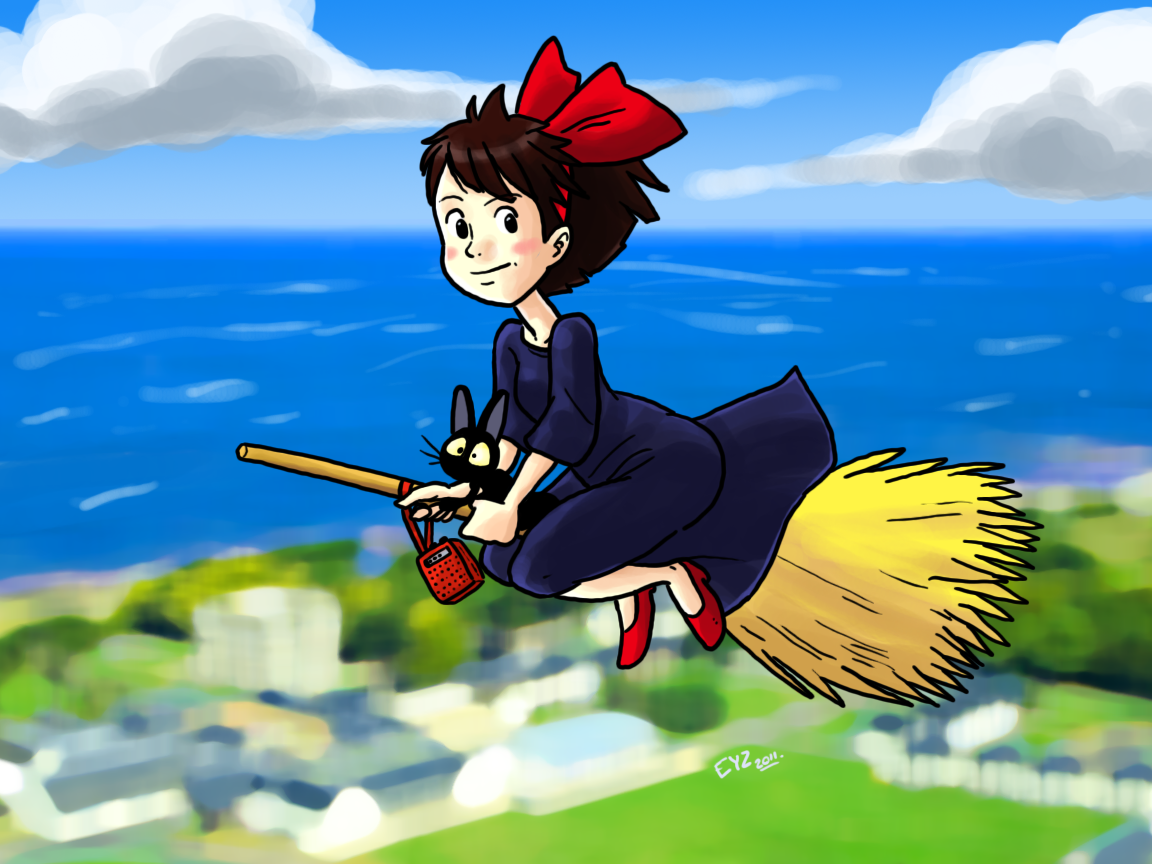
Eyz Drawing + 8-bits tune - Kiki's "Message of Rouge"

Here's a new drawing for a change!
I wanted to draw Kiki from Hayao Miyazaki's classic movie Kiki's Delivery Service for some time :P


And since I was thinking about that..
I love the opening Rock 'n' Roll theme so much, that I uploaded an 8-bits version of it on my youtube channel:


It came out pretty good I think, surprisingly!

The opening tune of Studio Ghibli's "Kiki's Delivery Service", "Rouge No Dengon" (Message of Rouge).
A very fun 60s style japanese rock and roll song!
Once again done using FL Studio 8 with the plugin magical8bit to simulate the 8 bits sound.
Hope you like it ;)
(and that youtube won't screw up the sound too much as usual!)