Here's another episode of...
Huh...
Me talking about stuff in blog-posts!
(...
blogging?)
This time I'd like to make a quick retrospective about
cartoon mascots videogame companies used to represent them, and their evolution over the years.
Since video games stopped being as abstract as the early Atari days and went on more defined visual ways (than, say, imaginative as in the original days), developers started making "cartoon" characters for the player to control and creating whole worlds and universes around them.
These mascots were more marketable, easily transferred into animation, books, toys, on t-shirts, etc...
And more than anything, they became big representations of the time they were created in and the brands that had them made.
I'm talking here about the beginning of the 2nd 8-bit generation, starting from the Nes era.
Videogames started to gain a certain appeal to a younger audience, and it wasn't anymore just marketed to the odd adults or punk teens that used to hang out around
the arcades.
8-bits GenerationInstead of just making up more classic "heroes", like Pitfall Harry, the Prince (of Persia), etc.... Cartoon started being in videogames, just like they started appearing in most of animated tv series for kids.
The first batch of these 8-bit cartoon mascots were at first mostly exagerated "human" mascots.
Mario started his career as
Jumpman, in Donkey Kong by
Nintendo.
He was basically the same as he ended up nowadays, only depicted a bit more Popeye-ysh in the promotional material.
Unlike the protagonists of Castlevania, Bionic Commando, Metal Gear and many more classics, Mario was clearly designed around an abstract concept and was an exagerated figure.
Let's not also forget sandbox games grandaddy,
Namco's
Pacman.
On a completly different tone than Jumpman, Pacman was more abstract.
One of the few non-man of all these "
Mascot-men" (you'll get this in a few sentence below...)
Like Mario, Pacman evolved a bit over the years but mostly stayed close to his original intend.
He's a big bright yellow ball eating ghosts.
And the premise is totally awesome put down like that!
Bomberman, another 80s classic, was created by
Husdon Soft. But gaming wise closer to that arcade feel.
Anyway the character got a bit more smooth, had an anime phase and changed according to the projects. (
Act Zero, Racing spinoffs, 3D games, adventure RPGs....)
Mega Man is a great example of the creativity of the 8-bit mascots that were imagined back then.
Design-wise, it's a well rounded character from
Capcom that could be easily done in simplistic graphics and recognisable.
Large gun, helmet, 2 shades of blue for his costume, a human recognisable face... Perfect!
You might have noticed a pattern going on.
All these characters were all the times called
Xsomething-Man, right?
Well, not all of them of course.
Like
Alex Kidd, created by
Sega as an answer to the rise of cartoon characters.
Only Alex never truly won an international appeal, though he was quite popular western Europe and South America.
Perhaps they should have called him something like Jingenko Man (though I'm sure the "Kidd" in his name was there for that)
Before him, Sega also tried once or twice other mascots to represent them, such as Opa Opa or Pengo...
Other companies also tried to create similar characters, but it wasn't until the 90s it really caught on....
16-bits GenerationWhen
Sega let
Sonic loose on the gaming scene, it was like a bomb exploded....
Sonic was different than the 8-bit mascots. No more mister nice guy/hero saves the girl (Mario..)/random character with no clear purpose (
Pacman, Bomberman..)
It was like the key to success was to make a sort of agressive anti-hero, a cool animal-ysh character with (hip) attitude!
The same movement was also seen in comics (but with muscular over-sized gun-wielding superheroes) and on tv/films (cool kids kickin'
Freddy Krueger's ass,
Parker Lewis who couldn't loose, etc..)
Sonic lead the way to a new era...
And everyone wanted a piece of that pie...
And even the old generation of mascots began to adapt.
While most stood the ground (
Mario, Bomberman..), tweaks were made here and there to sell a new image to kids.
Why?
Because by then mascots became the new major way to impose a brand, make a developer/publisher popular among the masses.
Instead of scrapping/redesigning Megaman,
Capcom created a side-series for the 90s,
Mega Man X.
Sporting a new cool attitude closer to Sonic, an agressive look and all~
Other adapted their icons (
Pacman evolved, obtained boxing gloves and red boots..)
And some incorporated such "poster" characters like this in their old franchise side by side their old heroes (Nintendo started marketing
Wario, an evil more agressive version of their old plumber)
With Sonic's success helping establish a new system in a market largely overtaken by Nintendo, it was the proof a good public relation and brand association was quite a powerful marketing tool.
Every company wanted to use image association with their names.
So came
Bonk, created by Hudson for their alliance with
NEC on the PC-Engine system.
Since he was another Hudson trademarked character, he and Bomberman shared quite a few spots and crossovers over different materials.
Bonk was declined in various games (and later on various systems), had spinoffs, cameos, etc..
(Zonk series..)
Two directions stared to clearly appeard.
Either mascots would follow Sonic's way and be hip, cool and fun - mostly the animal ones.
Or follow the old path, and like Mario, propose a more led back human relatable cartoon character established according to the old genre (like Bonk above).
These mascots started appearing everywhere, alongside company logos, their promo material, etc..
And the goal was clear, create franchises.
All good arcade game company that was popular enough since the 80s entered the game.
Sunsoft had Iguana Entertainment create and develop their new mascot, Aero the Acro-Bat.
Accolade had
Bubsy designed by a cartoonist.
Clearly another Sonic clone.
Most of these mascots were quite agressive, with in-your-face personas, taking the Sonic-trope to its maximum.
But they still were some exceptions like
Mr. Nutz,
Ocean representant.
His first impression might give a Sonic vibe, everything's here, the looks, the gloves, the design..
But his game was much more laid back and closer to Mario.
Like most of his type, his games were ported over several systems and had a sequel.
Since I can report all the mascots that were made for each company around that time, let's mention one or two more before moving on.
A lot of these characters were pretty big hits and misses that the companies had to believe in.
Basically, each arcade publisher, each gaming system and each company had these mascots representing them.
You think arcade, you think Namco, Konami, Capcom, Taito, etc..? They all had their own mascots.
And then the systems, PC Engine, Atari, Mega Drive, etc.. All had their own mascots.
Gremlin Graphics made
Zool as "the ultimate competitor" against Sonic, supposed to become the Amiga's mascot.
But the system failed comercially, and like most mascots, Zool survived his console and was ported over most other gaming devices after that.
As bad as his game and/or design was.
Let's also mention
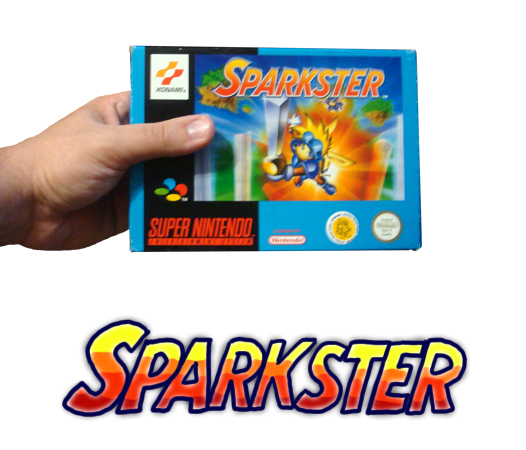
Sparkster, who's a personal favorite of mine.
Unlike Mario simplistic world or Sonic coolness/agressive atitude,
Konami clearly designed Sparkster as a responsible heroic figure.
Konami, another old classic arcade developer who missed the original batch of mascots from the 80s, unlike Namco (Pacman) or others, but entered the mascots scene in the middle of the Sonic craze.
32-bits GenerationWith the 32-bit era, the mascot genre kinda lost its speed.
The torch had been passed to RPGs as the new big thing-best selling genre.
And mascots, with their colorful and simple design were much more efficient in sidescrolling platformers than the first 3D RPGs.
Final Fantasy 7, 8 or Chrono Triggers were
in, Sonic and co were
out.
The mascots went in a totally different way.
Most companies stopped using them in the marketing campaigns and ads.
Capcom, for example, adapted Mega Man (instead of making up a new figure) for that new generation in another side-series.
The classic Mega Man and Mega Man X lived on, selling less titles maybe, but still alive and kicking.
Capcom new figure became Mega Man Legends, Mega Man in 3D with RPG elements.
A new group of 3D mascots appeared, to showcase what the systems could do now, and Mega Man quickly adapted to the medium.
Mascots were either, back to their roots, designed for kids again.
Like
Croc by Argonaut Software, who was supposed to become
Fox Interactive mascot, but slowly disappeared after a second disappointing game (sales-wise).
Softer, with a strong emphasis on 3D exploration, simple storytelling, colorful and happy tones.
Like
Mario and
Donkey Kong returned to fame in their Nintendo 64 episodes. (while cool 16-bit figures like
Wario slowly retired)
Or embraced a full-on edgy approach like
Rare's
Conker, who acted on the N64 as a sort of Mario/Donkey Kong antidote.
Crystal Dynamics tried to bring back people to the genre with
Gex, who ventured both into 2D and 3D games.
Gex had a more adult appeal, making obscure references and adult jokes here and there.
Maybe to sell their mascot to the old gaming generation that grew up playing games all those years?
He debuted in fact as the mascot for the 3DO...before it crashed so he moved over the other systems.
Ubisoft launched
Rayman as the mascot for the Atari
Jaguar too.
But after the system's failure, kept the lil' guy as their mascot.
Like I said, mascots were less presents, but some tried to keep them around.
Either as marketable children icons, or trying to keep the attitude alive, with edgier approaches.
Surely in this new generation,
Crash Bandicoot was the one that came the closer to capture Sonic's appeal only adapted to a 3D 32-bit era.
Crash was surely a winner from the start.
He had the fun, the spirit, the design and a great game to boot!
It never came out clear if he acted as an official mascot, either to Naughty Dog, the developer, or to Universal Interactive, it's publisher, but everyone figured him as the Playstation inofficial mascot.
(though a Nintendo 64 and a Saturn port were planified originally)
Meanwhile sister-company
Insomniac Games created Spyro to be Sony's mascot and he also ended up representing Universal, inversely. (he still appears to this day in various Vivendi Universal, and now Activision marketing such as their website, and a movie is rumoured to be made at some point)
On the Sega's side, the japanese editor had developers Hudson's developer Red Company (creators of Bonk, Zonk, etc..) make a brand new mascot for their ill-fated
32x system.
Since Sega let a lot of their arcade hits be converted for the PC Engine, it was only justice to send the elevator back to Sega.
Thus was born the 32x best representant and fan favorite obscure hit,
Tempo.
But the system was doomed from the start, specially with another 32-bit Sega system coming, the Sega Saturn.
Altough Tempo was popular enough to survive the 32x and have a port (on the Game Gear) and a sequel (on the Saturn itself!)
With Mario and Crash pushing the boundaries of 3D worlds in their respective systems, the Nintendo 64 and the Playstation, Sega needed the same for the
Saturn.
Which sadly never came out to be a new Sonic episode.
Hudson Soft started digging the way, playing with the Saturn hardware a bit, which was and still is to this day the best 2D system ever but suffers quite a lot in the 3D area.
Thus was born another anthropomorphic hero..at least it would have had the game been released outside Japan.
Hudson created
Willy Wombat, a pretty fun 3D platformers using 2D sprites, custom made for the Saturn.
The game was ready to be exported, with 100% of the in-game voices and most texts in-game in english..but for unknown reasons it never made it in Europe or America.
Would it have helped a bit the Saturn? With no proper Sonic around, perhaps...
At least
Bug! became, for lack of a better option, the Saturn's default mascot.
It wasn't really bad...just not good enough to make a stand amongst those better and more modern mascots.
128-bits GenerationWith one of gaming's oldest and classic developers pulling out of the systems market, mascots were almost obsolete by the 2000s.
Halo signed the end of the mascots as we knew them, cartoon funny characters.
Now the world of gaming was domined by realistic space marines and badass mercenaries.
I'm not surprised to see the return of old icons such as Metroid's Samus, the Bionic Commando and the likes.
Mega Man has once more upgraded to the ever changing gaming tastes of today's audience.
Altought initially, in the first part of the 128-bit era (Dreamcast, PS2, Gamecube, Xbox) , it seemed like the old series were done for with no more episodes planned in any of those older franchises.
Strangely, one or too new mascots still made it here and there.
Like the serious space marines, now a heckuva lot more detailled and with more complicated designs than ever. (seriously guys...how can you hope to interest children with these
undrawable character designs??)
The guys behind Sunsoft' Aero The Acro-Bat, now part of
Acclaim Entertainment, made
Vexx, a new take on the platformer genre.
Mascots aren't the same as they were as before... they won't ever be.
Now, the few remaining are adult, more serious in tone, with more colorful and unique personalities.
Most of the time agressive, badass. Though some tend to use an over the top action-like feel.
The
PS2 defacto mascot was Naughty's Dog
Jak & Daxter, now no more asssociated with either Crash Bandicoot or Vivendi Universel.
The same went on at Spyro's developers. Thus was born
Ratchet &
Clank.
Let's also mention other badass Ratched/Jak inspired modern mascots like
Ty the Tasmanian Tiger by Krome Studios/EA,
Sly Cooper from Sucker Punch Productions or the less menacing
Kao the Kangaroo (this one was similar in tone to Crash Bandicoot rather than Jak) by Tate Interactive.
Of course, there were others.
I'm just trying to get the maximum and the most varied type showed here.
Blinx was a pretty interesting take on the formula, since he was cleary created to become Microsoft's
Xbox mascot...until the surprising success of Halo and domination by the FPS genre for all this 128-bit era!
Wasn't he good enough or was the public too different to accept the kitty?
Let's see... nice gameplay mechanic (3D platformer with huge world to explore, tons of stuff to do and try), decent story, unique universe...even design-wise, he was created by Sonic co-creator himself Naoto Ōshima at Artoon games.
"Next Gen" GamingFinally came our modern era.
With Xbox 360s, PS3s and Wiis.
A brand new age...that has seen a surprising and unexpected revival in retro-gaming.
Playing old games has become mainstream and popular.
Old mascots are now popular again.
With digital distribution, lots of franchises have known new rebirths!
Be it the new Donkey Kong, Mario or Sonic 4 games, the old mascots seem to be back at it again.
Old gamers and the
new young audience finally appreciate having mascots around again, after all the
Call of Duty games,
Halos and other
Gears of War overdose.
It's not surprising to finally have all Mega Mans back around at the same time.
And it doesn't look like it's gonna stop anyday soon, with more planned such as a new Rayman game and more!
But what of the other original creations?
Not a lot of original new content seems to be developed sadly...
Though we have the occasional few new cartoon characters spawned for existing material.
Like Ubisoft new mascots, already replacing Rayman, the
Ravin' Rabbids.
Who after a couple of minigames compilations finally started exploring action platformers.
But before this return to greatness, we had to suffer through some strange experimentation.
Probably because of the success of "next gen" modern realistic gritty games.
Bomberman was totally re-imagined in the odd
Bomberman Act Zero.
I won't say it was that bad of an idea... maybe a more over-the-top angle would have worked there...but WHAT WERE THEY THINKIN'?!?
Sonic, himself, got totally f***ed up artistically and as a game in his modern consoles' debut, in his self titled adventure.
While
Crash lost any sign of whatever made him great to begin with in the past in a game that also doesn't feel like a Crash Bandicoot experience anymore...
We now have to look at the indie scene if we ever want to see new icons appear in this day and age.
Hear me out,
I'm glad of the revival mascots were able to go through the last couple of years.... (boy, do I feel old...)
It's great to see the popularity retro-gaming has brought along.
But mascots aren't as big of an interest that companies want to invest in.
Personally, they'll always be remembered as a big important part of videogames history for me. I will always associate companies with their mascots, even if they don't use 'em anymore, as much as their logo we all associate them with.
Some of these cartoon characters will always represent some companies, like Sega and Sonic, Nintendo and Mario, Hudson and Bomberman, etc...
The End. That's all folks!


 VGR: Sparkster: Rocket Knight Adventures 2
 Also available on /